Galaxies
Galaxies are huge groups of stars, gas, dust, and dark matter bound together by gravity. Typically, they contain billions to trillions of stars, along with their planetary systems and interstellar gas and dust. Galaxies can range in size from dwarfs with just a few billion stars to the largest galaxies known, which can contain one hundred trillion stars or more.
Most galaxies are between 10 billion and 13.6 billion years old. Some are almost as old as the universe itself, which formed around 13.8 billion years ago. Astronomers think the youngest known galaxy formed approximately 500 million years ago.
Galaxies can organize into groups of about 100 or fewer members held together by their mutual gravity. Larger structures, called clusters, may contain thousands of galaxies. Groups and clusters can be arranged in superclusters, which are not gravitationally bound. At the largest scales, the superclusters are arranged into sheets and filaments—the largest known structures in the universe.
Galaxy filaments are massive, thread-like structures spanning around 50 to 80 megaparsecs, with the largest being the Hercules-Corona Borealis Great Wall at around 3 gigaparsecs in length (although still unconfirmed). The filaments are separated by cosmic voids, which are vast spaces that contain very few or no galaxies, the largest being the KBC void (also known as the Local Hole).
The Milky Way is part of the Local Group, which is part of the Virgo Supercluster, which in turn is part of the Laniakea Supercluster. The KBC void contains the Milky Way and the Local Group, and the larger part of the Laniakea Supercluster.
Hubble Classification of Galaxies
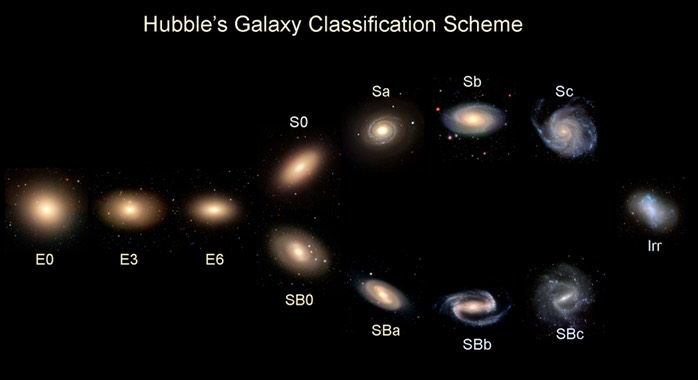
The Hubble classification scheme is a system used to classify galaxies based on their morphology. It was developed by Edwin Hubble in the 1920s and is still widely used today. The Hubble classification scheme divides galaxies into several main categories, including:
- Elliptical galaxies (E): These galaxies are characterized by their smooth, featureless appearance and are typically composed of older stars. They are classified based on their ellipticity, with E0 being nearly spherical and E7 being highly elongated. If the major and minor axes of the galaxy are and respectively, then its type is given by E, where .
- Lenticular galaxies (S0): These galaxies have a disk-like structure similar to spiral galaxies but lack the prominent spiral arms. They are often considered a transitional type between elliptical and spiral galaxies.
- Spiral galaxies (S): These galaxies are characterized by their spiral arms and a central bulge. They are classified based on the tightness of their spiral arms and the size of their central bulge. These can be further classified as Sa, Sb and Sc, where Sa has tightly wound spiral arms and a large central bulge, Sb has moderately wound spiral arms and a medium-sized central bulge, and Sc has loosely wound spiral arms and a small central bulge.
- Spiral Barred galaxies (SB): These galaxies have a central bar-shaped structure that extends from the nucleus to the spiral arms. They are classified in the same way as normal spiral galaxies, with the addition of the “SB” prefix. These can be further classified as SBa, SBb and SBc, where SBa has tightly wound spiral arms and a large central bulge, SBb has moderately wound spiral arms and a medium-sized central bulge, and SBc has loosely wound spiral arms and a small central bulge.
- Irregular galaxies (Irr): These galaxies do not fit into any of the above categories and have an irregular shape. They are often rich in gas and dust and are typically associated with active star formation.
A few more classifications, which are not part of the OG hubble classification are:
- SAB galaxies: These are spiral barred galaxies that have a weak central bar-shaped structure that extends from the nucleus to the spiral arms. They lie between S and SB galaxies in terms of their morphology.
- Sm galaxies: These are irregular galaxies that have a more regular shape than typical irregular galaxies. They are often rich in gas and dust and are typically associated with active star formation. These are shaped like the Magellanic clouds.
- dIrr galaxies: These are dwarf irregular galaxies that are found in the outskirts of galaxy clusters. They are typically small and have a low luminosity.
- dE galaxies: Dwarf elliptical galaxies
- dSph galaxies: Dwarf spheroidal galaxies
Galactic Relations
We define the galaxy effective radius or half light radius as the radius at which half of the total light of a galaxy is emitted. The radius is defined as the disk radius corresponding to a surface brightness of .
The mass to light ratio is a marker of the amount of mass per brightness contained within the radius . It is given by the total mass of the galaxy divided by its total luminosity. This ratio is approximately constant for each class of spiral galaxy, when integrating across the entire galaxy. The mass to light ratio is a useful tool for estimating the total mass of a galaxy, including dark matter, and can be used to study the dynamics and evolution of galaxies.
The de-Vaucouleurs profile describes how the surface brightness of an elliptical galaxy varies as a function of apparent distance from the center of the galaxy. It is given by the equation
The Tully-Fisher relation relates the luminosity of a spiral galaxy to its peak rotational speed . The Tully-Fisher relation can be expressed mathematically as
or , where , and are constants.
The Faber-Jackson relation relates the luminosity of an elliptical galaxy to its velocity dispersion . The Faber-Jackson relation can be expressed mathematically as
For quasars, the part of the quasar that is varying in brightness must be smaller than the distance light travels in the time it takes for the variation to occur.
Types of Galaxies
Except the hubble classification scheme, galaxies can be classified into several other types based on their properties and characteristics. Some of the most common types of galaxies include:
- CD galaxies: These are dwarf elliptical galaxies that are found in the central regions of galaxy clusters. They are typically small and have a low luminosity.
- uFd galaxies: These are ultra-faint dwarf galaxies that are found in the outskirts of galaxy clusters. They are typically very small and have a very low luminosity.
- UCD galaxies: These are ultra-compact dwarf galaxies that are found in the central regions of galaxy clusters. They are typically very small and have a very low luminosity.
- Radio galaxies: These are galaxies that emit strong radio waves, often associated with active galactic nuclei (AGN) or supermassive black holes. They can be classified into two main types: Fanaroff-Riley type I (FRI) and type II (FRII) radio galaxies, based on their radio morphology and luminosity.
- Quasars: Quasars are extremely luminous and distant active galactic nuclei (AGN) powered by supermassive black holes. They are among the most energetic objects in the universe and can outshine entire galaxies.
- Seyfert galaxies: These are a type of active galaxy that exhibits strong emission lines in their spectra. They are classified into two main types: Seyfert 1 and Seyfert 2, based on the strength and width of their emission lines. Seyfert I galaxies have broad emission lines, while Seyfert II galaxies have narrow emission lines.
- Blazars: These are a type of active galaxy that emits strong and variable radiation across the electromagnetic spectrum, including radio, optical, and X-ray wavelengths. They are thought to be powered by supermassive black holes and are often associated with jets of relativistic particles.
- AGN: Active Galactic Nuclei (AGN) are the central regions of galaxies that are extremely bright and energetic due to the presence of supermassive black holes. AGN can be classified into several types, including Seyfert galaxies, quasars, and blazars, based on their properties and characteristics.