General Relativity
General Theory of Relativity is a theory of gravitation that was developed by Albert Einstein in the year 1915. It describes gravity not as a force, but as a curvature of spacetime caused by the presence of mass and energy. The theory has been confirmed by numerous experiments and observations, and has become a cornerstone of modern physics. In this section, we will explore some of the key concepts and phenomena related to general relativity, including orbits in curved spacetime, gravitational waves, and the precession of apsis.
Albert Einstein (1879-1955) was a German-born theoretical physicist who developed the theory of relativity, one of the two pillars of modern physics (alongside quantum mechanics). He is best known for his mass-energy equivalence formula , which has been dubbed “the world’s most famous equation”. Einstein’s work has had a profound impact on our understanding of the universe, and he is widely regarded as one of the greatest scientists in history.
Aside from the theory of special and general relativity, Einstein made significant contributions to the development of quantum mechanics, statistical mechanics, and cosmology. He received the Nobel Prize in Physics in 1921 for his explanation of the photoelectric effect, which was a key step in the development of quantum theory. Einstein’s legacy continues to influence physics and our understanding of the universe to this day.
The four tests of general relativity are:
- The perihelion precession of Mercury’s orbit
- The deflection of light by the Sun
- The gravitational redshift of light
- The Shapiro time delay of light passing near a massive object
The test for the deflection of light by the Sun was first performed during a solar eclipse in 1919 by Sir Arthur Eddington, and provided one of the first pieces of evidence in support of general relativity. The other tests have also been confirmed by various experiments and observations over the years, further solidifying the theory’s status as a cornerstone of modern physics.
Orbits in General Relativity
Orbits in general relativity are more complex than those in Newtonian mechanics due to the curvature of spacetime. The equations governing the motion of bodies in a gravitational field are derived from Einstein’s field equations, which relate the curvature of spacetime to the energy and momentum of matter and radiation. Here, we shall explore the properties of orbits in general relativity, including the existence of stable and unstable circular orbits.
Consider a system of a massive central mass being orbited by a smaller mass , such that the central body is essentially at rest. The energy analogue in general relativity is given by
Here is a term related to the energy of the system, and is the specific angular momentum of the orbiting body.
The above equation is derived from the Schwarzschild metric, which describes the spacetime geometry around a non-rotating, spherically symmetric mass. The additional term compared to the Newtonian case arises due to the curvature of spacetime and leads to significant differences in the behavior of orbits, especially near massive bodies like black holes.
The Schwarzschild metric was the first exact solution to Einstein’s field equations, found by Karl Schwarzschild in 1916. It is given by
where is the metric on the unit sphere. The Schwarzschild radius is a critical radius at which the escape velocity equals the speed of light, and it defines the event horizon of a black hole.
We shall talk more about metrics when discussing cosmology.
For a circular orbit, , which gives the radius of the orbit as
We see that for a given angular momentum , two circular orbits are possible. Introducing and the schwarschild radius ,
Therefore for a circular orbit, . This puts a limit on the minimum angular momentum of the body ().
The inner orbit
is unstable, while the outer orbit
is stable. The stability of the orbits can be determined by analyzing the second derivative of the effective potential, which shows that the inner orbit corresponds to a local maximum (unstable) and the outer orbit corresponds to a local minimum (stable).
Therefore the minimum radius of a stable circular orbit is when
An orbit at this radius is known as the innermost stable circular orbit (ISCO). This means that for a non-rotating black hole, any matter that comes within this radius will inevitably spiral into the black hole, while matter outside this radius can potentially form an accretion disk and emit radiation. The ISCO is an important concept in astrophysics, as it determines the inner edge of the accretion disk around a black hole and has implications for the emission of X-rays and other high-energy radiation from the vicinity of black holes.
In the limit ,
From the equation, we see that circular orbits with radius smaller than are not possible. An object that has crossed this boundary can still escape the black hole if it has enough energy, but it cannot maintain a stable orbit. It must accelerate to escape, and if it fails to do so, it will eventually spiral into the black hole.
Moreover, the orbit with radius is known as the photon sphere, and it represents the closest distance at which light can orbit a massive body in a circular path (in fact, this is the only circular orbit possible for massless particles). This is an unstable orbit, and any perturbation will cause the photon to either fall into the black hole or escape to infinity. The photon sphere is a unique feature of the spacetime around a black hole and has important implications for the behavior of light and the appearance of black holes.
Precession of apsis in General Relativity
It was noted in the mid-19th century by Urbain Le Verrier that the apsis of Mercury’s orbit precesses at a rate of arcseconds per century, which could not be explained by Newtonian mechanics. This was one of the first pieces of evidence for general relativity, which could explain this anomalous precession. We shall show how to calculate this precession using two methods: the precession of the LRL vector, and using the orbit equation in general relativity.
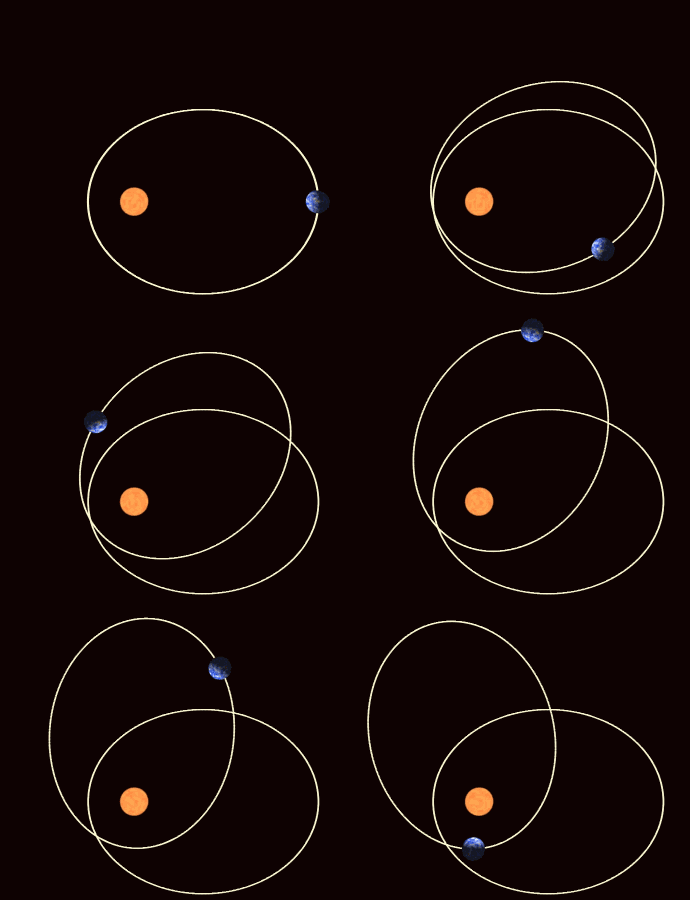
Precession of LRL vector under a perturbed potential
Consider a small perturbation to the potential energy , such that
Since the force is no longer inverse-square, the LRL vector is no longer conserved, and precesses, leading to precessing of apsis.
Since and are still conserved, the magnitude of remains constant. Writing ,
where . The average precession of the apsis
The rate of precession is therefore given by
If the perturbation is small, the orbit during one revolution can be approximated as Keplerian
and hence the integral can be evaluated.
For example, the potential due to a point mass in general relativity is given by
Evaluating the integral gives
Using the orbit equation
The orbit equation in general relativity is given by
Defining a dimensionless and ,
Since is very small, we can use perturbation methods to find an approximate solution for . In the first order, can be expanded in terms of a power series as
just gives the newtonian solution
For , we get
This gives the solution for as
Putting everything together and neglecting the small terms, we get
The period of the ellipse is not , and hence precesses at a rate of
which matches the result which we obtained via the precession of the LRL vector.
Gravitational Waves
Gravitational waves are waves of spacetime curvature that propagate at the speed of light and are produced by the relative motion of gravitating masses. They were predicted by Einstein in 1916 as a consequence of his general theory of relativity, and were first directly detected by the LIGO and Virgo collaborations in 2015. The sources of gravitational waves include binary systems of compact objects (like black holes and neutron stars), supernovae, and the early universe.
Consider two massive bodies and orbiting each other, with position vectors and relative to the center of mass. We define and .
According to general theory of relativity, accelerated masses with non zero quadrupole moments radiate gravitational waves (GWs) and lose energy. For small enough velocities, the emitted GWs
- have a frequency twice as large as the orbital frequency
- can be characterized by a luminosity, which is dominated by the expression
where is the orbital separation and is the angular velocity of each mass.
The energy of the system is . Differentiating, we get
where we define the chirp mass .
Now, gives
where is a constant of integration.